
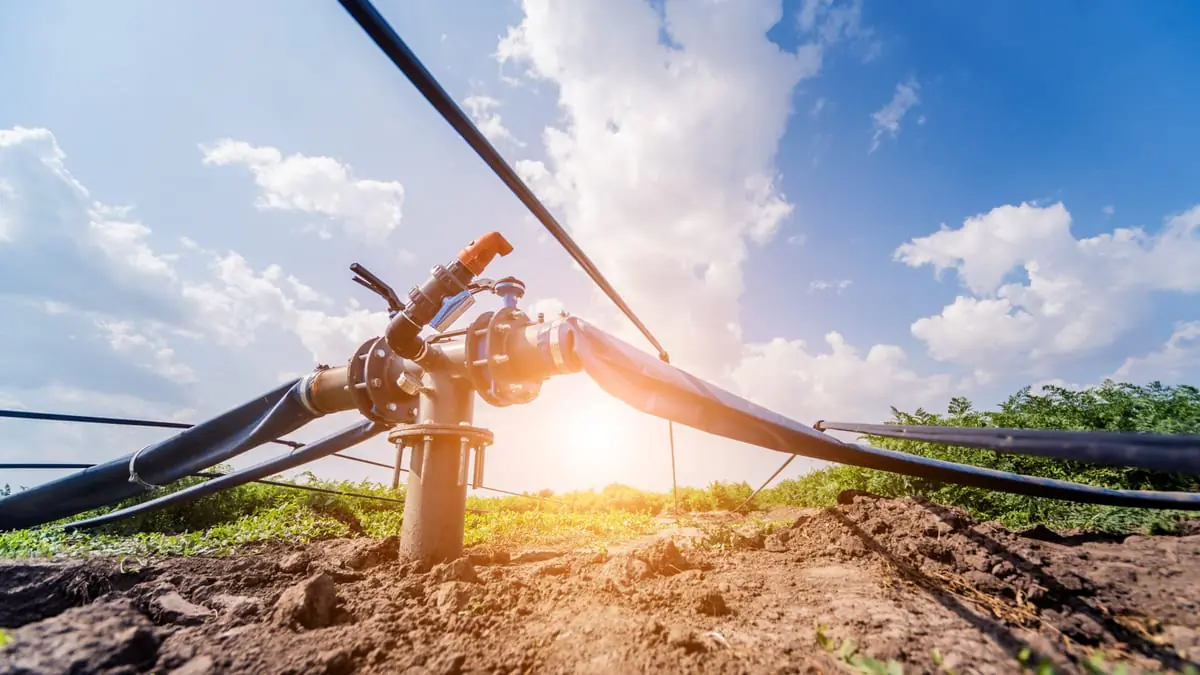
Smart farming, through advanced technologies, is revolutionising how we manage natural resources, especially water.
Smart farming, through advanced technologies, is revolutionising how we manage natural resources, especially water. Efficient irrigation management is critical to a sustainable agriculture and to minimising production costs. Through weather stations, soil moisture sensors, irrigation algorithms and satellite data, smart farming helps farmers reduce water use and improve crop efficiency. Let's see how all these pieces work together to deliver significant benefits.
1. Recording rainfall with weather stations
Using weather stations is the first step towards efficient water management in irrigation. These stations record rainfall in real time, giving farmers accurate information about weather conditions and the water nature provides. This allows better irrigation planning, as farmers know exactly when and how much water their crops need. In areas with limited water resources, this accurate recording helps avoid waste.
2. Soil moisture sensors: precise moisture data
Placing moisture sensors in the soil offers valuable data on soil moisture at depth and at different points across the field. These sensors inform the farmer in real time about exact moisture levels, allowing him to plan the duration and intensity of irrigation. If the soil is already sufficiently wet from rain or a previous irrigation, the need for extra water decreases. Accurately recording this data optimises irrigation applications and avoids overuse of water.
3. Irrigation algorithms: exact volume and timing
Irrigation algorithms use data from moisture sensors, weather stations and other sources to calculate exactly the volume and timing of irrigation. Instead of arbitrary calculations, they offer a scientific approach that accounts for plant needs, weather conditions and soil moisture. This ensures water is used only when and where necessary, reducing consumption while safeguarding crop health and growth.
4. Deficit irrigation: better, faster growth
Deficit irrigation is a technique applied when water is limited and farmers choose to supply less than the maximum the crop would need for full growth. Although less water is supplied, correct application can produce higher-quality, faster-growing plants. It suits crops that tolerate lower water volumes while also saving resources.
5. Satellite data: guiding the irrigation schedule
Satellite data offer valuable information on soil temperature, canopy cover and growth, providing a highly accurate map of crop condition. With this information farmers can plan the irrigation schedule with greater precision. Satellite data give a broad view of the field, catching anomalies that are hard to spot by other methods, such as moisture patterns or irrigation needs in specific parts of the field.
In conclusion
Smart farming offers a revolutionary way to manage natural resources, especially water. Through weather stations, soil moisture sensors, irrigation algorithms and satellite data, farmers can apply precise and efficient irrigation methods, saving water and money while ensuring better crop development. These technologies are the future of agriculture, contributing to sustainability and production efficiency.
Want the numbers for your own farm?
Our team estimates your water, energy and spraying savings based on your crop and location.