
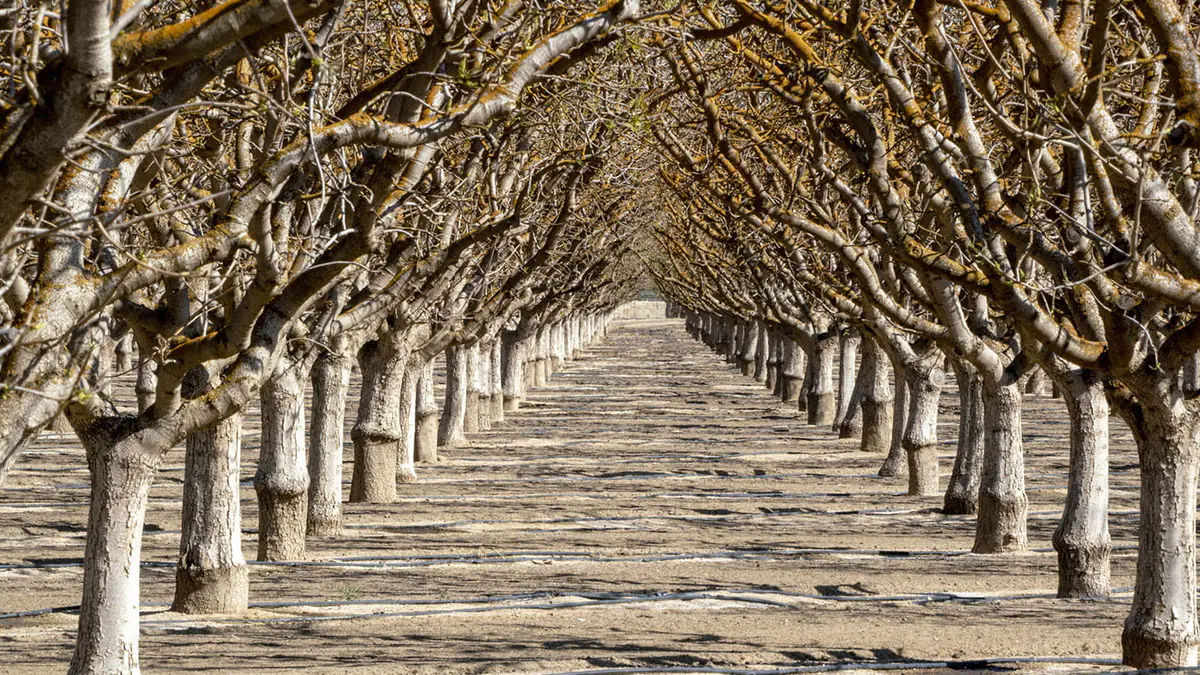
Winter is not dead time for the field. See how chill units are measured, what the Weinberger, Utah and Dynamic models mean, and how Agrivate's telemetric station turns winter cold into a predictable harvest.
As autumn advances and the growing season closes, fruit trees — olive, almond, hazelnut, cherry, peach, apple — enter winter dormancy. It is a biological pause that is not dead time: inside it, the tree measures the cold it receives and decides when to wake up.
To wake smoothly in spring, flower at the same time and deliver a high yield, trees must accumulate a specific number of chill units. If the winter is too warm — an ever more common event because of climate change — buds fail to open properly, flowering is uneven and production collapses.
Winter, then, is not dead time for the field. With the Agrivate platform, a grower no longer guesses whether it was cold enough: they track the progress of their trees' dormancy with numerical precision, preparing the ground for a successful spring.
What chill units are and why they decide the harvest
Chill Units are a measure of how much “useful cold” a tree has accumulated from autumn to spring. They are not a simple temperature log: each temperature band carries a different biological value and, in some models, very high temperatures subtract units already accumulated.
When a tree fails to reach its required units, the symptoms are specific and measurable: delayed and drawn-out flowering, uneven bud break, reduced fruit set, smaller and less uniform fruit, and greater frost sensitivity caused by asynchronous flowering.
The opposite mistake is costly too. Low-chill varieties planted in cold regions wake too early, are exposed to late frosts and lose a whole season's production in a single night. Knowing chill accumulation is, in practice, a planning tool rather than a mere measurement.
The three calculation methods on the Agrivate platform
In the Agrivate dashboard a grower monitors three different measurements at once. Each offers a different level of accuracy, and comparing them is more informative than any single figure.
1) Chill Hours — Weinberger model (e.g. 1088 h)
How it is calculated: it simply counts the total hours the field temperature fell below 7.2 °C (45 °F), regardless of how far it dropped.
Advantage: it is the simplest, most traditional method, with decades of historical data and immediate comparability across years and regions.
Disadvantage: it is incomplete, because it treats one hour at 1 °C as equal to one hour at 6 °C — and ignores that very high midday temperatures cancel part of the night's cold. In regions with strong day-to-night swings it systematically overestimates available chilling.
2) UTAH model (Utah Chill Unit Model — e.g. 1611.5 CU)
How it is calculated: it awards chill points depending on each temperature's biological effectiveness, in bands:
• 2.5 °C to 9.1 °C: full point (1 CU per hour) — the ideal range for the tree. • 9.2 °C to 12.4 °C: half a point (0.5 CU per hour). • Below 1.4 °C or above 16 °C: no contribution (0 CU). • Above 18 °C: negative score — high temperatures “burn” chill units accumulated earlier.
Why it stands out: it delivers much greater accuracy in regions with within-day temperature swings, because it explicitly penalises warm spells instead of ignoring them. The trade-off is that it remains a linear model: it does not distinguish the order in which temperatures occurred.
3) Dynamic Model (e.g. 907.0 CP)
How it is calculated: it counts Chill Portions (CP) and rests on the theory that chill accumulation is an irreversible two-stage process. First an intermediate, heat-labile molecule forms; if it stays cold long enough, it converts into a permanent chill portion.
Why it is the future: it is considered the most advanced and scientifically accurate model worldwide, especially for Mediterranean regions with mild winters. Because a formed Chill Portion is not lost to a single warm day, the Dynamic Model withstands the chilling “interruptions” that break linear models.
Its drawback is practical: it is far more complex and requires hourly, continuous data from an in-field station. That is why in practice it is computed only by software — such as Agrivate — and not by hand.
Which model a Greek grower should use
Greek winters are typically mild, with warm midday spells and large swings within the same day — precisely the conditions under which linear models misestimate available chilling, either under- or over-counting depending on the area.
The practical recommendation: the Dynamic Model (Chill Portions) is the most reliable basis for critical decisions — dormancy-breaking schedules, variety selection, pruning timing. Chill Hours and UTAH remain useful as a historical indication and as a bridge to multi-year data and to variety requirements, which are usually quoted in chill hours or CU.
The mistake to avoid: comparing numbers from different models. 900 CP is not equivalent to 900 CU and does not map to 900 chill hours, because the scales are entirely different. Comparison is meaningful only within the same model, the same location and the same season.
How Agrivate calculates them automatically
Agrivate combines hourly data from the in-field microclimate weather station with real conditions, not interpolated values from remote weather networks. The station records temperature, humidity, VPD and leaf wetness at the field's own location, where conditions can differ markedly from the nearest town.
The grower needs to do nothing manually. The system automatically computes chill hours, Utah Chill Units and Chill Portions, tracks bud-break progress and gives a clear picture of whether — and when — the tree has met its variety's requirement. Data is compared against previous seasons, so the trend, not just the current value, becomes visible.
How a grower puts this data to work in practice
Forecasting flowering uniformity: knowing a variety's requirement — say, an almond variety needing 400 CP versus a cherry needing 800 CP — a grower knows whether the tree has met its needs and can forecast whether flowering will be uniform or staggered.
Dormancy-breaking applications: if the winter is warm and CP stays low, the grower can schedule dormancy-breaking products in good time — applied at the correct moment, which is critical to their effectiveness.
Correct pruning timing: pruning can be scheduled from the tree's dormancy stage rather than strictly by the calendar. Heavy pruning before dormancy completes can delay bud break and cost yield.
Protecting flowering from frost: knowing the bud stage tells the grower how frost-sensitive the buds are, allowing frost-protection measures to be organised in advance instead of reacting after the damage.
Choosing the right variety: a site's historical chill data is the safest guide for variety selection in a new planting or replant, avoiding mistakes that cost years.
Conclusion: winter cold is data, not guesswork
Chill units turn a vague feeling — “how cold was the winter?” — into a measurable index that decides flowering, fruit set and ultimately yield. The three models Agrivate tracks are not competitors: Chill Hours and UTAH provide historical context and comparability, while the Dynamic Model (Chill Portions) provides the accuracy critical decisions demand.
For the professional grower the conclusion is practical: with a telemetric in-field station and automatic chill-unit calculation, winter stops being a season of uncertainty. It becomes the period in which the next harvest is prepared, with numerical certainty.
Want the numbers for your own farm?
Our team estimates your water, energy and spraying savings based on your crop and location.
More articles
07/09/2026
The Digital Revolution in Olive Farming: How Agrivate Takes Precision Irrigation to the Next Level
29/08/2026
Smart Hazelnut & Almond Harvesting: How Microclimate Data Maximize Yield and Kernel Quality
28/06/2026
Data-Driven Irrigation: The Answer to Water Meters, Electricity Costs and Climate Change